

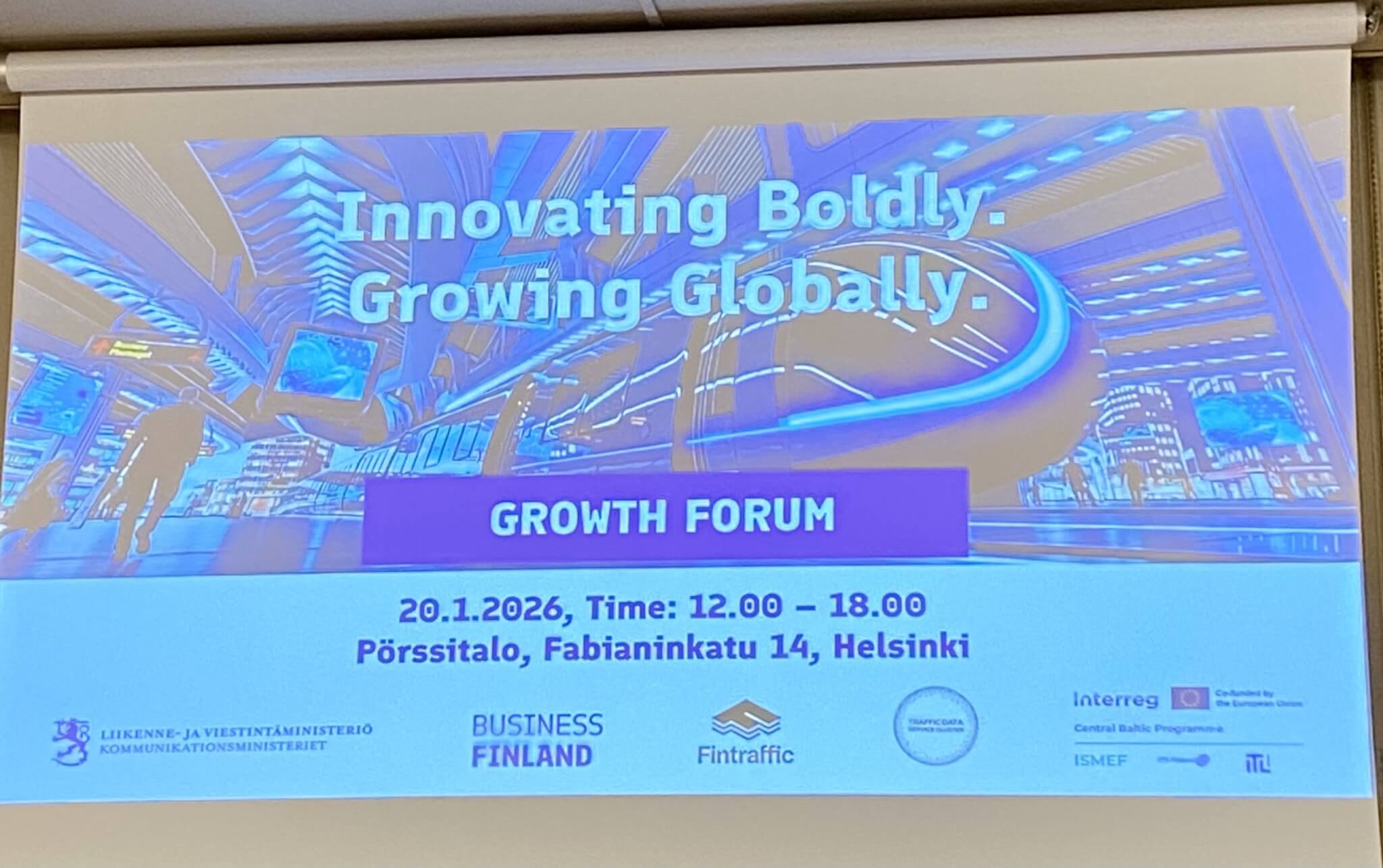
On 20 January 2026, I joined Growth Forum 2026 in Helsinki, a smart mobility-focused event organized around one core mission: helping Nordic companies scale through exports, partnerships, and radical innovation. (ITS Finland)
With my team at Global Edge Markets, I am focused on one question: What actually helps Nordic companies move from “great technology” to scalable international growth?
Growth Forum offered its own set of answers: collaboration beats isolation, speed matters, and the winners will be the companies (and countries) that intentionally reduce friction—especially through digital infrastructure, data, and trust. (ITS Finland)
A shared Nordic message: “Scale faster, together”
The event was moderated by Jenny Simonsen, ITS Norway and Sanni Remonen, ITS Finland, setting the tone: growth is a team sport, and internationalization works best when we build momentum as a cluster—not as isolated companies. (Business Finland)
Clear theme repeated throughout the day:
If we want exports, we need more collaboration across borders, deeper trust networks, and shared market-entry infrastructure.

Inka Mero, Voima Ventures: Finland’s “time tax” problem—and what fixes it
The strongest presentation came from Inka Mero, Voima Ventures, who framed Finland’s competitiveness challenge not as a lack of talent, but as a growing productivity and scalability gap.
She raised difficult but necessary points: Finland has faced weak GDP growth relative to peers, and we can’t afford to operate in “hibernation mode” while others move faster.
The concept that stuck with me most was her idea of the “time tax”—the accumulated drag created by bureaucracy, slow processes, redundant work, and outdated systems.
And the opportunity? Building a stronger intangible economy powered by data flows, automation, and AI, especially in high time-tax sectors like logistics, healthcare, and construction.
Inka’s underlying point was simple, but sharp:
We do not need incremental improvement—we need structural acceleration.
Kedi Välba (ITL Estonia / Aktors): trust is growth infrastructure
Another strong presentation came from Kedi Välba, who reinforced a lesson Estonia has institutionalized:
Digital infrastructure is not “tech modernization.” It’s economic infrastructure.
Estonia’s success isn’t just digitization—it’s interoperability, trust, and governance, deliberately designed to reduce friction and scale capability across society.
Her framework resonated strongly with what we see in scaling companies:
- Trust enables data sharing – Data sharing enables innovation
- Reducing friction lowers the cost of growth
- Public/private collaboration becomes the multiplier
This is not abstract policy talk. It’s a practical growth model.

Market signals: the US and UK are open—if you build relationships early
The event also included international market “windows” from the United States and the UK, reinforcing what global growth leaders already know: You build market presence over time through partnerships and credibility.
Finland’s strengths for US partnerships—trust, transparency, and deep technical innovation—were clearly highlighted, along with the need to invest in long-term relationship building. (Business Finland)
The UK segment reinforced that while there is opportunity, it’s also a highly regulated market where entry requires patience, legal support, and endurance.
The scaling reality check: after MVP, internationalization can’t wait
The panel discussion brought together a grounded view of what scaling actually takes—especially for SMEs.
A few insights that matched my own experience working with growth-stage teams:
- Within 12 months after MVP, companies should already be looking internationally
- Many home markets are simply too small or too stagnant
- Partnerships with “in-market experts” reduce risk dramatically
- Sales + communication are trust-building skills, not just commercial functions
Several speakers emphasized that collaboration through associations and clusters helps build visibility faster and gives smaller companies access to networks they can’t reach alone.
One point that surfaced repeatedly: it’s difficult for SMEs to know who to trust in new markets, especially when procurement is slow and stakeholder landscapes are unfamiliar.
This is exactly why “soft infrastructure” matters—introductions, credibility, and reputational signaling.
Fireside Chat: the mobility leaders are sitting on city-scale value
One of the most practical parts of the event was the fireside conversation featuring
- Starship Technologies (autonomous delivery robots)
- Bolt (multi-service mobility platform)
- Wolt (delivery and convenience at scale)
What stood out was how much mobility growth today is shaped by data access, policy relationships, and city partnerships. Mobility platforms hold datasets that cities often can’t generate alone. Smart mobility isn’t just a product category—it’s a systems transformation.
From local pilots to global proof: VTT and the Smart Rail Ecosystem
The session on the Smart Rail Ecosystem (VTT) highlighted how Finland can create globally relevant industrial innovation —especially when hardware, simulation, and software development are integrated.
From driver training simulators to anti-collision systems evolving into commercial products, it’s a clear example of how Finnish ecosystems can produce exportable breakthroughs when scale pathways are designed intentionally.
Final takeaway: scaling is a strategic discipline—not an outcome
Commercial growth comes from reducing friction, building trust, and creating repeatable pathways to international markets.
The next phase of competitiveness will come from:
- Designing faster processes and digital infrastructure
- Building export readiness earlier (not later)
- Going to markets as clusters, not single players
- Treating trust and relationships as growth assets
- Using data as a strategic advantage—not a byproduct
I left the event feeling optimistic—especially because the solutions are not mysterious. They are actionable. And the companies building for global markets are already here.
Interested in discussing growth pathways for mobility, deep-tech, or industrial scale-up?
I’m open to conversations around internationalization strategy, partnership building, and commercial acceleration—especially for teams building critical infrastructure for the future.