

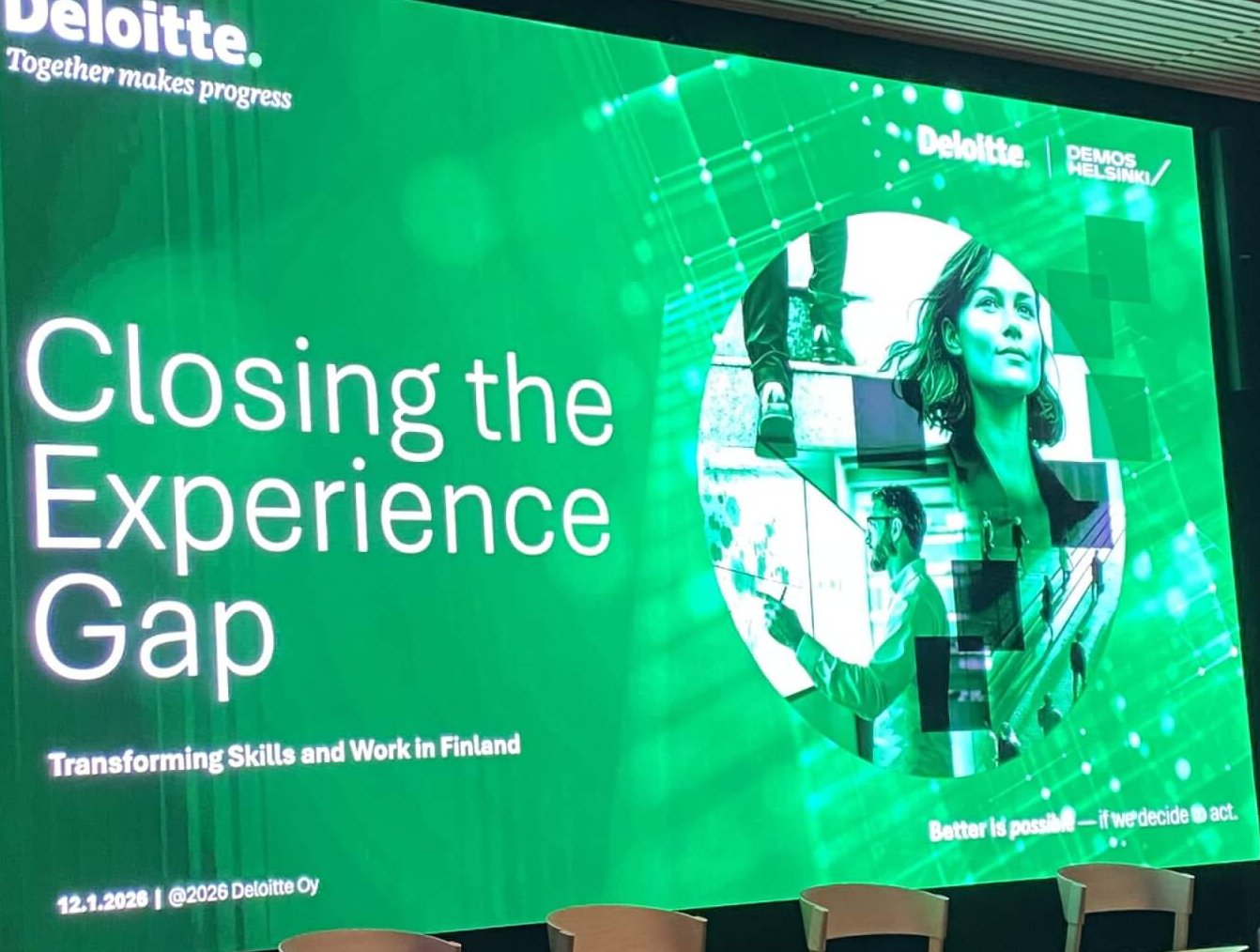
Finland has been “driving in roundabouts” for too long. The country knows change is needed, yet reforms remain fragmented and cautious. Despite world-class infrastructure, strong scientific foundations, and deep cultural investment in education and equality, the nation has experienced two decades without meaningful economic growth.
At this week’s “Better is Possible” seminar hosted by Deloitte , leaders from academia, industry, and public policy echoed a clear theme: Finland cannot afford incremental adaptation any longer—systemic renewal is imperative.
This imperative aligns directly with the work I lead and the services that GlobalEdgeMarkets delivers to Nordic organizations: helping companies evolve from innovation excellence into internationally competitive, commercially effective, growth-oriented enterprises.
1. Experience Gap to Learning Leap
Lari Hintsanen (Deloitte) & Otso Sillanaukee (Demos Helsinki) emphasized skills and learning as the foundation of Finland’s future —but with an important caveat. Learning cannot remain confined to traditional degree structures. The future requires:
- Broader, multidisciplinary education with transferable skills
- Continuous learning embedded into work life
- Radical integration between education and employment
Finland currently has fewer entry-level roles that allow people to grow into expertise. Recruitment systems increasingly filter for experience, even as new roles emerge with no experienced workforce to draw from.
This creates a paradox: we demand readiness, but we under-invest in pathways that create it. Learning must become a strategic capability inside organizations, not a personal after-hours responsibility.
2. Commercialization as a National Capability
Finland must embrace commercialization as a core competency, not an afterthought.
- Innovation without commercialization does not generate GDP growth.
- Research, ideas, and prototypes need structured pathways to market.
- Startups and universities alike must embed commercialization frameworks earlier and more deeply into their cultures.
For Finland, this means shifting from publishing papers to launching products and companies that compete globally.
3. Technology Is Not the Strategy
Dr. Timo Seppala (Aalto University) offered a critical reminder that reframed much of the technology discussion: AI is not the goal—it is a tool.
Universities, he noted, have discussed AI for decades. Yet most companies only began to feel its impact after 2018. When industry and academia operate at arm’s length, organizations fail to prepare their people, processes, and workflows for what is coming.
Dr. Seppälä emphasized that technological change is always socio-technical. Tasks change. Roles change. Value creation changes. Closer collaboration between universities and companies enables employees to move from lower-skill to higher-skill work, something other countries are already pursuing aggressively.
Dr. Joonas Tuhkuri (Stockholm University) brought the discussion back to fundamentals: what actually makes labor valuable. When societies increase the share of work requiring higher expertise, wages rise and GDP follows. Finland must consciously cultivate high-value expertise, starting early and supporting it all the way into productive work.
4. Commercialization, Communication and Mobility.
The final panel surfaced a friction point – there is declining trust in the future. Young people struggle to access internships and early work experience. Funding models incentivize graduation, not transition into work.
Susanna Niinistö-Sivuranta Haaga-Helia University of Applied Sciences , Teija Saari Metso / Wärtsilä , Johanna Vesikallio Nuorten yrittäjyys ja talous NYT – JA Finland highlighted a theme that often remains implicit in Finnish discussions: the lack of appreciation and training for commercial, communication, and sales skills.
Not as “soft skills,” but as core economic capabilities. Finland excels at building things. It struggles more with: productization, marketing communication, sales execution, and a tolerance for iterative learning.
Yet these are precisely the skills that turn knowledge into impact, research into revenue, and innovation into jobs. Without them, even the best technology remains under-leveraged.
The panel also emphasized internal mobility—promoting from within, enabling cross-functional movement, and creating visible growth paths for employees. Career stagnation is not just an individual problem; it is a systemic productivity issue.
Rebuilding Means Reconnecting
Rebuilding Finland’s future is not about choosing between knowledge and commerce, or between education and work. It is about integrating them into a coherent system that continuously converts learning into value.
International commercialization, communication, and sales are not distractions from Finland’s goals. They are the mechanisms through which those goals become real. We have world-class talent and world-class institutions. What it needs now is a culture of execution—the capability to convert ideas into economic outcomes.
Finland has rebuilt before. With purposeful alignment between education, business, and global markets, it can do so again—becoming a great place to thrive.
Learn more about the “Better is Possible” societal impact platform and report.